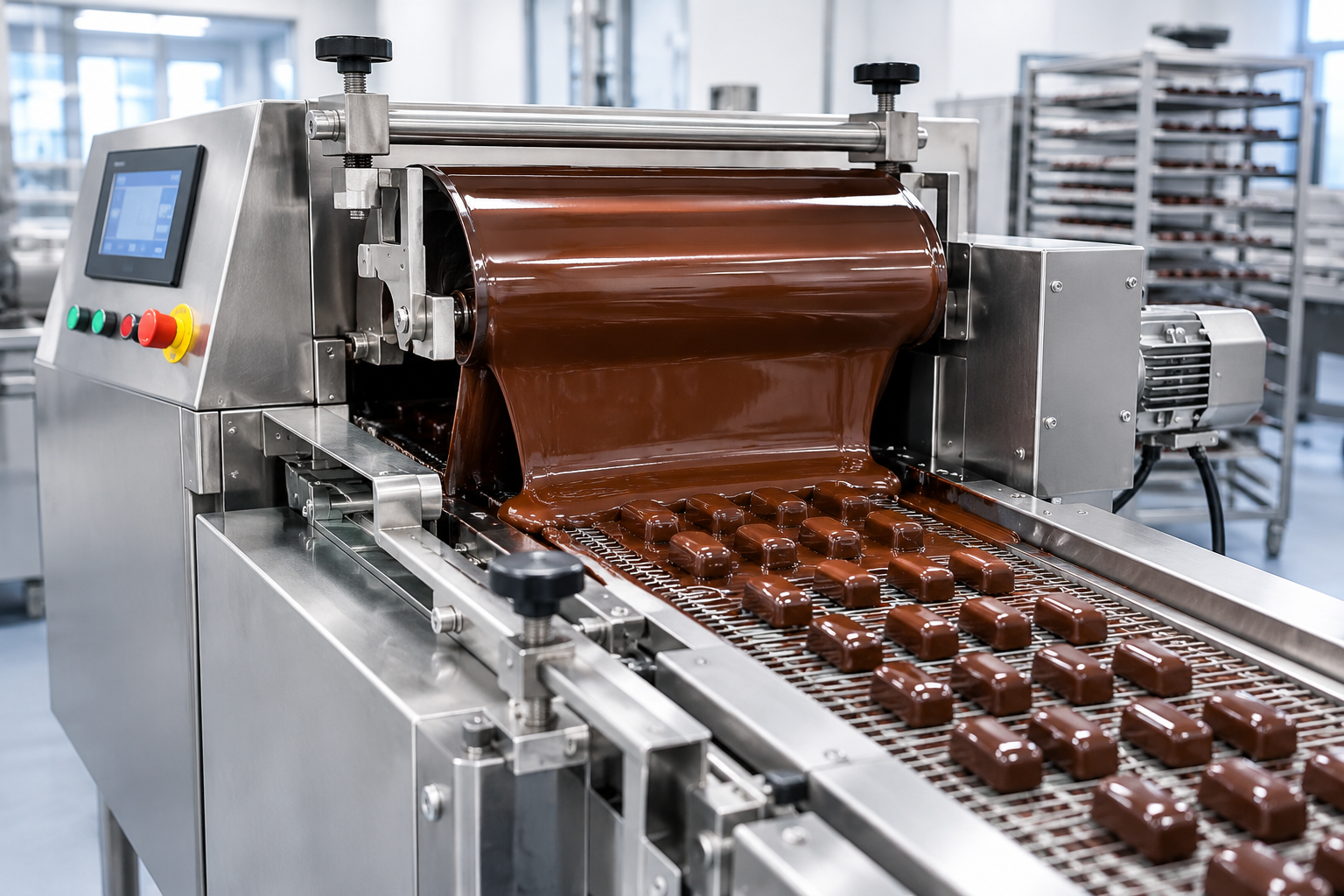
Chocolate coating machines have become an essential part of modern food manufacturing, especially in the confectionery industry where consistency, speed, and product quality matter. These machines apply a smooth, even layer of chocolate over food products such as biscuits, wafers, nuts, candies, cookies, fruits, and snack bars. Whether production is carried out on a small commercial scale or in a large industrial facility, chocolate coating machines help achieve a uniform finish while reducing manual work and improving production efficiency.
As consumer demand for chocolate-coated snacks and desserts continues to grow, manufacturers are investing in equipment that produces consistent coatings with minimal product waste. Today's machines are designed to maintain the ideal chocolate temperature, control coating thickness, and support continuous production without compromising quality.
This guide explains how chocolate coating machines work, why they are important, the different types available, their industrial applications, maintenance practices, and the latest developments shaping chocolate manufacturing in 2026.
What Is a Chocolate Coating Machine?
A chocolate coating machine is a specialized food processing machine that covers products with a controlled layer of melted chocolate. The process is designed to create an attractive appearance, improve texture, and add flavor while maintaining uniform coating thickness across every product.
The machine typically works with tempered chocolate, which is maintained at a carefully controlled temperature to ensure proper crystallization. This allows the chocolate to set with a glossy appearance, smooth texture, and desirable snap after cooling.
Chocolate coating machines are used for products with different shapes and sizes, from small candies to large bakery items. Depending on production requirements, machines may operate in batch mode or continuous production mode.
Why Chocolate Coating Machines Are Important in Food Manufacturing
Chocolate-coated products require a consistent finish that is difficult to achieve through manual methods. Chocolate coating machines automate this process while maintaining high standards of hygiene and production quality.
In food manufacturing, appearance plays a significant role in consumer expectations. A uniform chocolate layer improves visual appeal while ensuring every product has similar taste and texture characteristics. Machines also reduce chocolate wastage by recycling excess coating back into the system.
Automation also supports manufacturers in maintaining production speed during periods of high demand. Instead of relying on manual dipping or coating, production lines can continuously process thousands of products with consistent results.
How Chocolate Coating Machines Work
The chocolate coating process involves several carefully controlled stages that ensure chocolate is applied evenly and solidifies correctly.
The process begins with chocolate melting and tempering. Chocolate is heated to specific temperatures and then cooled in a controlled manner to create stable cocoa butter crystals. Proper tempering prevents dull surfaces, blooming, and uneven texture.
Products are then placed on a conveyor belt that moves through the coating section. A curtain or waterfall of liquid chocolate flows over the products, completely covering their surface. Depending on the machine design, chocolate may flow from above, below, or both directions simultaneously.
After coating, excess chocolate is removed using vibrating conveyors or controlled air blowers. This step creates a uniform coating thickness while preventing chocolate accumulation around the base of products.
Finally, coated products move through a cooling tunnel where chocolate hardens under controlled temperature and humidity conditions before packaging.
Main Components of a Chocolate Coating Machine
Chocolate coating machines consist of multiple integrated systems working together throughout the coating process.
A chocolate melting tank heats and stores liquid chocolate before it enters the coating section. Temperature control systems continuously maintain the chocolate within the required range.
The conveyor system transports products through coating, vibration, and cooling stages at adjustable speeds depending on product size and coating thickness.
The coating curtain distributes chocolate evenly across the product surface, while air knives or blowers remove excess chocolate without damaging delicate products.
Cooling tunnels gradually reduce product temperature, allowing chocolate to crystallize correctly and maintain its glossy finish.
Modern machines also include digital control panels that allow operators to monitor temperature, conveyor speed, chocolate flow, and production settings.
Types of Chocolate Coating Machines
Different chocolate coating machines are designed for different production capacities and product types.
Chocolate Enrobing Machines
Chocolate enrobing machines completely cover products as they pass through a curtain of chocolate. They are commonly used for biscuits, wafers, cakes, cookies, and snack bars where full coverage is required.
Chocolate Panning Machines
Chocolate panning machines coat small products inside a rotating drum. Nuts, almonds, raisins, coffee beans, dried fruits, and candies are repeatedly tumbled while chocolate is gradually added in layers until the desired coating thickness is achieved.
Batch Chocolate Coating Machines
Batch coating machines process a fixed quantity of products during each production cycle. They are suitable for smaller food businesses, specialty chocolate manufacturers, and research or development environments.
Continuous Chocolate Coating Machines
Continuous machines are designed for high-volume manufacturing where products move constantly through automated production lines. These machines provide consistent output with minimal manual intervention.
Chocolate Tempering and Why It Matters
Tempering is one of the most important steps in chocolate coating because it determines the final appearance and texture of the chocolate layer.
Properly tempered chocolate produces a shiny surface, crisp snap, and smooth mouthfeel while reducing the risk of fat bloom during storage.
Chocolate coating machines often include automatic tempering units that continuously circulate chocolate through heating and cooling zones. This maintains stable crystal formation throughout production.
Without proper tempering, coated products may develop a gray or white appearance, lose gloss, or become soft after cooling.
Products Commonly Made Using Chocolate Coating Machines
Chocolate coating technology is used across many segments of the food industry.
Bakery manufacturers coat cookies, biscuits, waffles, donuts, and cakes with milk, dark, or white chocolate. Snack manufacturers produce chocolate-coated granola bars, protein bars, rice cakes, popcorn, and cereal clusters.
The confectionery industry uses coating machines for chocolates, toffees, marshmallows, caramel candies, and gummies. Nut processors coat almonds, peanuts, hazelnuts, pistachios, and cashews.
Fruit processors also use chocolate coating equipment for strawberries, cherries, banana chips, raisins, and freeze-dried fruits.
Benefits of Using Chocolate Coating Machines
Chocolate coating machines improve product quality and manufacturing efficiency in several ways.
Uniform coating ensures consistent taste, texture, and appearance across every product in a production batch. Automated temperature control reduces the chances of chocolate defects caused by overheating or improper crystallization.
Continuous chocolate recycling minimizes waste by returning excess chocolate to the circulation system. This improves ingredient utilization while maintaining hygiene standards.
Automation also increases production capacity, reduces manual labor requirements, and helps manufacturers maintain consistent quality during long production runs.
The ability to adjust conveyor speed and chocolate flow allows manufacturers to produce different products using the same equipment with minimal adjustments.
Industries That Use Chocolate Coating Machines
Chocolate coating machines are widely used beyond traditional chocolate manufacturing.
Confectionery factories rely on coating systems for mass production of chocolate candies and filled treats. Bakery industries use them to produce coated cookies, wafers, pastries, and cakes.
Snack food manufacturers create chocolate-covered popcorn, cereal snacks, protein bars, and energy bars. Nut processing facilities produce chocolate-coated almonds and mixed nuts.
Frozen dessert manufacturers also use chocolate coating technology for ice cream bars and frozen confectionery products that require a quick-setting chocolate shell.
Specialty food producers increasingly use chocolate coating equipment for premium handmade products while maintaining consistent quality.
Factors That Affect Chocolate Coating Quality
Several production variables influence the final appearance and performance of chocolate-coated products.
Chocolate viscosity determines how thick or thin the coating becomes. Conveyor speed influences the amount of time products remain under the chocolate curtain.
Airflow settings control the removal of excess chocolate without creating uneven surfaces. Cooling tunnel temperature affects chocolate crystallization and final gloss.
Product temperature also matters. If products enter the coating section too warm or too cold, chocolate adhesion and setting behavior may change.
Maintaining stable environmental conditions throughout production helps prevent common coating defects.
Maintenance and Cleaning Best Practices
Regular maintenance helps chocolate coating machines operate efficiently while maintaining food safety standards.
Chocolate contact surfaces should be cleaned after production to prevent chocolate buildup and contamination between batches. Conveyors, nozzles, pumps, and coating curtains require regular inspection for residue accumulation.
Temperature sensors should be checked periodically to ensure accurate chocolate tempering. Cooling tunnel airflow systems also require cleaning to maintain consistent cooling performance.
Lubricating mechanical components according to manufacturer recommendations helps reduce wear on moving parts such as conveyors and motors.
Routine inspections also help identify worn seals, hoses, or pumps before they affect production quality.
Recent Trends in Chocolate Coating Machines in 2026
Chocolate manufacturing equipment continues to evolve with automation and energy-efficient technologies.
Modern chocolate coating machines increasingly feature touchscreen control systems that store production recipes for different products. Operators can quickly switch between coating settings for various chocolate types and product sizes.
Energy-efficient heating systems help reduce power consumption while maintaining stable chocolate temperatures throughout production.
Many manufacturers are adopting automated cleaning systems that reduce downtime between production batches while supporting hygiene standards.
Real-time production monitoring allows operators to track chocolate temperature, conveyor speed, coating consistency, and production performance through digital dashboards.
Improved cooling tunnel designs also provide better humidity control, helping manufacturers produce glossy chocolate coatings even in challenging environmental conditions.
Choosing the Right Chocolate Coating Machine
Selecting a chocolate coating machine depends on production goals, product variety, and manufacturing scale.
Production capacity should match expected daily output while allowing room for future expansion. Manufacturers should also consider product dimensions, coating thickness requirements, and compatibility with different chocolate varieties.
Temperature control accuracy is important for maintaining chocolate quality throughout production. Easy cleaning and maintenance features help reduce downtime and improve operational efficiency.
For manufacturers producing multiple chocolate-coated products, flexible machines with adjustable conveyor speeds and programmable settings provide greater production versatility.
The Future of Chocolate Coating Technology
Chocolate coating technology is becoming increasingly intelligent, efficient, and adaptable. Automation, digital monitoring, and precision temperature control are helping manufacturers produce higher-quality products with less waste and greater consistency.
Future systems are expected to integrate more advanced sensors that automatically adjust coating thickness, chocolate flow, and cooling conditions in real time. Sustainable manufacturing practices are also influencing equipment design, with greater focus on energy efficiency and reduced ingredient loss.
As consumer demand grows for premium chocolates, healthier snacks, and innovative confectionery products, chocolate coating machines will continue to play a central role in delivering consistent quality across a wide range of food products.
Conclusion
Chocolate coating machines are essential equipment in modern confectionery and food manufacturing because they combine precision, consistency, and production efficiency in a single automated process. By carefully controlling chocolate tempering, coating application, vibration, and cooling, these machines create attractive chocolate-coated products with reliable quality and texture.
From biscuits and snack bars to nuts, fruits, and candies, chocolate coating machines support a wide variety of food applications across commercial and industrial production. Regular maintenance, proper temperature management, and appropriate machine selection help ensure long-term performance and consistent product quality.
As chocolate manufacturing continues to embrace automation and smart production technologies in 2026, chocolate coating machines are becoming more efficient, hygienic, and adaptable, making them an important part of modern food processing operations and future-ready confectionery production.