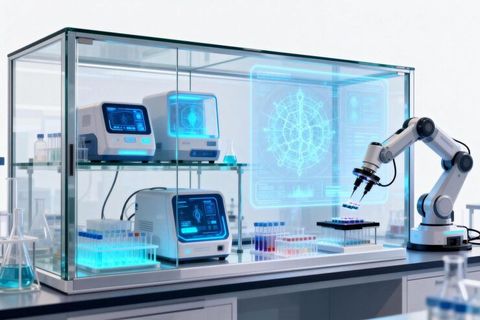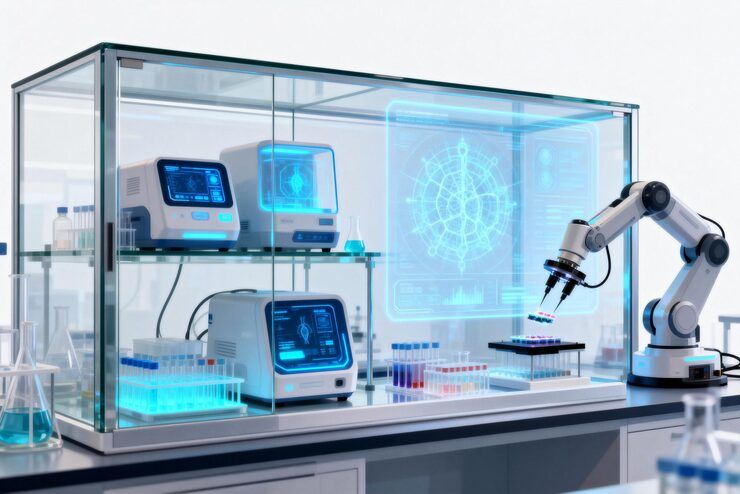
Automated lab equipment has become an important part of modern scientific research, healthcare diagnostics, pharmaceutical development, biotechnology, and industrial testing. These systems use programmed instruments, sensors, robotics, and software to perform laboratory tasks with reduced manual intervention. They help laboratories manage repetitive procedures, process samples consistently, and organize complex workflows.
Traditional laboratory work often requires technicians to measure liquids, prepare samples, operate instruments, record observations, and transfer results between different systems. As testing volumes increase, these activities can place pressure on staff and laboratory resources. Automation helps address these challenges by performing defined tasks according to established procedures.
However, laboratory automation does not eliminate the need for skilled professionals. Scientists and technicians remain responsible for selecting appropriate methods, reviewing results, maintaining equipment, and ensuring that testing procedures meet quality requirements.
Understanding automated lab equipment involves exploring its main types, practical applications, advantages, limitations, and selection criteria. This knowledge helps laboratory managers, researchers, students, and technical professionals understand how automation fits into different laboratory environments.
What Is Automated Laboratory Equipment?
Automated laboratory equipment refers to instruments and integrated systems that perform laboratory operations using programmed controls or predefined workflows. Depending on the application, automation may involve simple electronic measurement, automatic sample processing, robotic handling, or connected systems that coordinate several instruments.
Some equipment automates a single task, such as dispensing a specific volume of liquid. Other systems combine multiple operations, including sample identification, preparation, testing, data collection, and result transfer.
Laboratory automation can be divided into three broad categories. Standalone automation handles a particular procedure, such as liquid dispensing or sample analysis. Integrated automation connects multiple instruments to coordinate a series of laboratory operations. Fully automated workflows combine equipment, software, sample tracking, and automated handling to manage larger portions of a testing process.
The appropriate level of automation depends on sample volume, workflow complexity, required precision, available space, and the laboratory's quality objectives.
Common Types of Automated Lab Equipment
Automated Liquid Handling Systems
Automated liquid handling systems transfer, mix, dilute, and dispense liquids according to programmed instructions. They are commonly used in molecular biology, pharmaceutical research, clinical laboratories, and biochemical testing.
These systems can handle small liquid volumes and prepare multiple samples in a consistent sequence. Depending on their design, they may support applications such as reagent preparation, serial dilution, assay setup, and microplate filling.
Liquid handling automation helps reduce repetitive pipetting and can improve consistency when properly configured. Nevertheless, performance depends on liquid properties, calibration, dispensing technique, and the condition of the equipment.
Laboratory Analyzers
Automated laboratory analyzers perform measurements on prepared samples using specific analytical methods. Clinical laboratories may use them for biochemical, immunological, hematological, and other diagnostic testing.
An analyzer can automate steps such as reagent addition, sample measurement, signal detection, and preliminary result processing. This allows laboratories to manage routine testing through standardized workflows.
Different analyzers are designed for different sample types and testing methods. Their capabilities should be evaluated according to analytical accuracy, processing capacity, required maintenance, and compatibility with the laboratory's procedures.
Robotic Sample Handling Systems
Robotic sample handling systems move laboratory materials between designated locations, instruments, storage units, or processing stations. They may use robotic arms, automated tracks, grippers, barcode readers, and controlled storage systems.
These systems are particularly useful when laboratories process many samples or need to coordinate several testing stages. Automated handling can reduce unnecessary manual transfers and support more consistent sample identification.
Safe operation requires reliable sample tracking, suitable container compatibility, clearly defined movement paths, and protective measures around moving equipment. Human supervision remains important when handling exceptions, damaged containers, or unexpected system behavior.
Automated Microscopy Systems
Automated microscopy systems combine imaging equipment, motorized stages, software, and image analysis tools to support repeatable observation and measurement.
They are used in cell biology, pathology research, materials science, microbiology, and other fields where images provide useful analytical information. Some systems automatically capture images from selected locations, adjust focus, or identify features according to defined analytical criteria.
Automation can make image collection more consistent and help researchers examine large numbers of samples. However, image quality, sample preparation, analytical settings, and algorithm limitations can influence the results. Expert review may still be necessary, particularly when findings have important scientific or clinical implications.
Automated Centrifuges and Sample Preparation Equipment
Automated centrifuges and sample preparation systems help standardize procedures used before analysis. Depending on the equipment, these systems may support sample separation, heating, mixing, incubation, filtration, or other preparation steps.
Automated preparation reduces the need for repeated manual handling and helps coordinate timing across batches. This can be useful in laboratories where sample preparation represents a substantial part of the overall workflow.
Users must ensure that sample containers, rotor configurations, operating parameters, and preparation methods are appropriate for the intended application.
Laboratory Information Management Systems
A laboratory information management system, commonly called a LIMS, is software used to manage laboratory samples, workflows, records, and results. Although it is not necessarily a physical instrument, it plays an important role in connected laboratory automation.
A LIMS can assign sample identifiers, track sample status, organize test requests, record processing information, and support reporting. When integrated with compatible instruments, it may also transfer data between systems and reduce manual data entry.
Reliable integration requires consistent data formats, access controls, appropriate validation, and clear procedures for correcting errors. Software automation is only as dependable as the data and processes supporting it.
How Automated Laboratory Systems Work
A typical automated laboratory workflow begins with sample registration and identification. A barcode or another approved identification method connects the sample with its associated records and testing requirements.
The sample then moves through the necessary preparation and analytical stages. Depending on the workflow, automated equipment may measure reagents, mix materials, incubate samples, perform measurements, or capture images.
Sensors and software monitor selected operating conditions and coordinate the instruments. Results are recorded and transferred to the appropriate information system, where they can be reviewed, interpreted, and reported according to laboratory procedures.
Quality-control checks help determine whether the equipment and analytical method are performing within acceptable limits. If the system detects an error or an unusual condition, it may generate an alert or stop the relevant process.
The exact workflow varies by application. Laboratories should document each stage, define how exceptions are handled, and establish clear responsibilities for human review.
Benefits of Automated Lab Equipment
One important benefit of laboratory automation is improved workflow consistency. Programmed procedures can apply the same sequence of operations across multiple samples, helping reduce variation associated with repetitive manual tasks.
Automation can also increase sample-processing capacity. Equipment that handles multiple samples in a coordinated sequence allows laboratory staff to devote more time to analytical review, method development, troubleshooting, and other specialized responsibilities.
Reducing unnecessary manual transfers may lower the risk of sample mix-ups and contamination, provided the system has appropriate identification, handling, and cleaning controls. Automated data transfer can also reduce transcription errors and improve record organization.
Another advantage is traceability. Connected equipment and laboratory software can record information about sample processing, instrument status, and analytical results. These records help support quality management and investigation when results are unexpected.
The actual benefits depend on the equipment, laboratory procedures, staff training, maintenance practices, and suitability of the automation for the task. Automation alone does not guarantee accurate results.
Applications Across Different Industries
In healthcare diagnostics, automated analyzers support routine testing by processing samples according to established laboratory methods. This helps clinical laboratories organize workloads and manage testing requirements.
Pharmaceutical laboratories use automation in drug discovery, compound screening, formulation research, and analytical testing. Automated liquid handling and robotic systems can support experiments involving large numbers of samples.
Biotechnology laboratories use automated equipment for molecular biology workflows, cell-based research, and sample preparation. Automation can improve repeatability when procedures involve many similar steps.
Food and beverage laboratories may use automated instruments for quality testing, composition analysis, and contamination screening. Environmental laboratories can apply automation to water analysis, soil testing, and monitoring of selected chemical parameters.
Industrial laboratories also use automated testing systems to assess materials, manufacturing samples, and product characteristics. In each setting, equipment must be suitable for the sample type, analytical method, and applicable quality requirements.
Factors to Consider When Selecting Automated Lab Equipment
Selecting automated laboratory equipment begins with understanding the work that needs to be performed. Laboratories should evaluate sample volume, required throughput, analytical precision, workflow complexity, and the types of materials being processed.
Compatibility is another major consideration. Instruments must support the laboratory's sample containers, reagents, testing methods, and information systems. Equipment that cannot integrate with existing workflows may create additional handling steps instead of simplifying operations.
Laboratory space, electrical requirements, ventilation, temperature conditions, and other environmental needs should also be assessed. Users should consider routine maintenance, calibration, consumables, software updates, technical support, and staff training as part of the overall operational commitment.
Data management and security are especially important when instruments handle sensitive research information or clinical records. Access controls, reliable backups, audit trails, and appropriate system validation help maintain data integrity.
Before implementation, laboratories should establish acceptance criteria and verify that the system performs as intended under actual working conditions. Training, documented procedures, and ongoing performance monitoring help ensure that automation remains suitable as testing requirements change.