Industrial robotics tools have become one of the most important technologies in modern manufacturing and industrial automation. Across factories, warehouses, automotive plants, electronics facilities, and logistics centers, robotic systems are helping industries perform repetitive, precise, and complex tasks with greater consistency. As businesses continue adopting automation to improve productivity and maintain quality standards, industrial robotics tools have evolved into intelligent systems capable of working alongside humans in many environments.
Unlike traditional machines designed for a single fixed operation, industrial robots are programmable and adaptable. They can perform multiple manufacturing processes by changing tools, software instructions, or operating sequences. This flexibility allows industries to respond to changing production needs while maintaining efficiency and reducing operational downtime.
Understanding industrial robotics tools helps manufacturers, engineers, students, and technology professionals learn how automation is shaping industries today and what developments are expected in the coming years.
Understanding Industrial Robotics Tools
Industrial robotics tools refer to the hardware, software, and end-effectors used by industrial robots to complete manufacturing and production tasks. These tools allow robotic arms and automated systems to interact with materials, components, machines, and production lines with high accuracy.
An industrial robotic system typically combines several technologies into one integrated solution. The robot receives instructions from a controller, uses sensors to understand its surroundings, and performs tasks using specialized tools attached to its arm or operating mechanism.
Modern industrial robotics tools are designed to support industries that require precision, speed, repeatability, and safe automation across a wide range of applications.
Why Industrial Robotics Tools Matter Today
Manufacturing industries face increasing demands for faster production, consistent product quality, workplace safety, and operational efficiency. Industrial robotics tools help address these challenges by automating tasks that are repetitive, physically demanding, or require extremely precise movements.
Automation also supports industries experiencing labor shortages or increasing production volumes. Robots can operate continuously with consistent performance, making them valuable in environments where production schedules are demanding.
As Industry 4.0 technologies become more common, industrial robotics tools are increasingly connected with artificial intelligence, machine vision, cloud monitoring, and predictive maintenance systems. This creates smarter manufacturing environments capable of making data-driven operational improvements.
Main Components of Industrial Robotics Tools
Industrial robotics systems consist of multiple interconnected components that work together during manufacturing operations.
Robotic Arm
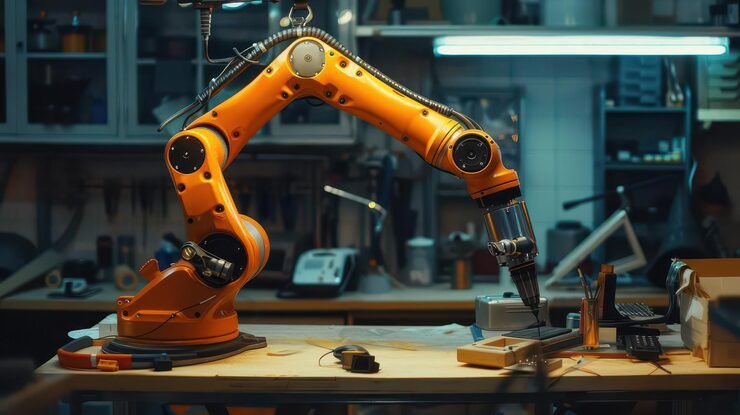
The robotic arm is the primary mechanical structure responsible for movement. Multiple joints allow the arm to rotate, extend, lift, and position tools in different directions. Different robot designs provide varying degrees of freedom depending on the application.
End-of-Arm Tooling
The end-effector is the tool attached to the robot's arm. It interacts directly with products or materials and determines what task the robot performs. End-effectors can be changed depending on production requirements, making industrial robots highly adaptable.
Robot Controller
The controller functions as the robot's brain. It processes programmed instructions, coordinates movement, communicates with sensors, and manages operational sequences during manufacturing.
Sensors and Vision Systems
Sensors help robots detect objects, monitor position, measure force, identify obstacles, and inspect product quality. Vision systems use cameras and image processing to recognize shapes, orientations, colors, and defects.
Safety Systems
Industrial robotics tools include emergency stop systems, protective barriers, safety scanners, collaborative safety sensors, and monitoring software to reduce workplace risks during automated operations.
Different Types of Industrial Robotics Tools
Industrial robots use specialized tools depending on the manufacturing process they perform. Each tool is designed for specific production tasks.
Gripping Tools
Grippers allow robots to pick up, move, and position objects. Different gripping mechanisms handle metal parts, plastic components, glass, electronics, food packaging, and other materials with varying levels of force and precision.
Welding Tools
Robotic welding tools automate spot welding, arc welding, laser welding, and precision joining processes. These tools provide consistent weld quality while reducing manual exposure to heat and sparks.
Cutting Tools
Robots equipped with cutting tools perform laser cutting, plasma cutting, waterjet cutting, and mechanical trimming for industrial materials including metal, composites, plastics, and textiles.
Painting and Coating Tools
Painting robots apply coatings evenly across products using controlled spray systems. These tools improve finish quality while minimizing material waste and maintaining consistent coating thickness.
Assembly Tools
Assembly robots use screwdrivers, fastening tools, insertion devices, adhesive dispensers, and precision positioning tools to assemble products with repeatable accuracy.
Inspection Tools
Inspection robots use cameras, scanners, lasers, and measurement sensors to verify dimensions, identify defects, inspect weld quality, and maintain manufacturing standards.
Common Types of Industrial Robots
Industrial robotics tools are installed on different robot platforms designed for various manufacturing needs.
Robot Type | Typical Industrial Use |
| Articulated Robots | Welding, assembly, handling, machine tending, painting. |
| SCARA Robots | Electronics assembly, packaging, precision component placement. |
| Cartesian Robots | CNC machining, pick-and-place operations, material movement. |
| Delta Robots | High-speed packaging, food processing, pharmaceutical production. |
| Collaborative Robots | Human-robot collaboration, light manufacturing, inspection, assembly. |
Each robot type supports different tools depending on production requirements.
How Industrial Robotics Tools Work in Manufacturing
Industrial robotics tools operate through programmed workflows that coordinate movement, sensing, and task execution. The production process begins with software instructions that define robot positions, movement speed, force limits, and operational sequences.
Sensors collect information about the work environment while the controller processes this data in real time. The robotic arm positions its tool accurately, performs the required task, and moves to the next operation according to the production program.
In advanced manufacturing environments, robots communicate with conveyors, CNC machines, automated storage systems, quality inspection equipment, and manufacturing execution systems to create synchronized production lines.
Industries That Use Industrial Robotics Tools
Industrial robotics tools are widely used across multiple industries because automation requirements differ from one sector to another.
Automotive Manufacturing
Automotive production uses robots for welding, painting, assembly, material handling, sealing, inspection, and battery manufacturing. Robotics supports consistent vehicle production while improving manufacturing efficiency.
Electronics Manufacturing
Electronics production requires high precision when assembling circuit boards, placing micro-components, soldering, testing devices, and inspecting finished products.
Food and Beverage Industry
Robotics assists with packaging, sorting, palletizing, labeling, quality inspection, and hygienic product handling in food processing facilities.
Pharmaceutical Industry
Industrial robotics tools help automate packaging, laboratory handling, medicine inspection, sterile manufacturing processes, and material transport within pharmaceutical facilities.
Metal Fabrication
Robots perform cutting, grinding, polishing, welding, machine loading, and heavy material handling in fabrication workshops and industrial plants.
Warehousing and Logistics
Automation systems use robotic tools for picking, sorting, palletizing, inventory movement, packaging, and automated warehouse operations.
Benefits of Industrial Robotics Tools
Industrial robotics tools provide significant operational advantages across manufacturing and industrial environments.
One of the biggest benefits is improved consistency. Robots perform identical movements repeatedly without fatigue, reducing variations between products.
Automation also increases productivity by performing tasks continuously across multiple production shifts. This helps manufacturers meet growing production demands while maintaining quality standards.
Industrial robotics tools improve workplace safety by handling hazardous materials, heavy lifting, hot surfaces, toxic environments, and repetitive tasks that may increase injury risks for workers.
Quality control also improves because robotic inspection systems identify defects early during manufacturing, reducing production waste and improving overall product reliability.
Another advantage is flexibility. Many robotic systems allow quick tool changes and software updates, making production lines adaptable for different products or manufacturing processes.
Recent Trends in Industrial Robotics Tools During 2025–2026
Industrial robotics technology continues evolving through smarter automation systems and digital manufacturing innovations.
Artificial intelligence is becoming more integrated into robotics software. AI helps robots recognize objects, optimize movement paths, detect anomalies, and improve production efficiency through machine learning.
Collaborative robots are expanding across industries because they are designed to work safely near human operators in shared workspaces. These robots support flexible manufacturing without requiring fully isolated robotic cells.
Machine vision technology has become more advanced, allowing robots to identify complex objects, inspect product quality, and adapt movements based on real-time visual information.
Cloud-connected robotics platforms allow manufacturers to monitor robot performance remotely, analyze production data, schedule predictive maintenance, and receive operational insights from connected equipment.
Digital twins are also becoming more common in industrial automation. Virtual models simulate robotic production lines before deployment, helping engineers optimize workflows and reduce implementation risks.
Industrial Robotics and Industry 4.0
Industry 4.0 represents the integration of automation, connectivity, data analytics, artificial intelligence, and smart manufacturing technologies.
Industrial robotics tools play a central role in Industry 4.0 by connecting robotic systems with sensors, industrial networks, cloud platforms, and manufacturing software.
Connected robots can exchange production information with machines, inventory systems, maintenance platforms, and quality management software. This enables real-time production monitoring and data-driven decision-making across factories.
Predictive maintenance also becomes possible because sensors continuously monitor vibration, temperature, motor performance, and operational conditions before failures occur.
Safety Considerations for Industrial Robotics Tools
Safe robotics operation remains an essential part of industrial automation. Modern robotic systems include multiple safety mechanisms designed to protect workers and equipment.
Safety systems monitor robot speed, workspace boundaries, collision detection, emergency stop conditions, and human presence near collaborative robots.
Manufacturing facilities also establish operating procedures, employee training programs, maintenance schedules, and equipment inspections to maintain safe robotic environments.
Collaborative robotics introduces additional safety technologies such as force limiting, speed reduction, proximity sensing, and controlled interaction with nearby workers.
Challenges of Industrial Robotics Adoption
Although robotics provides many operational benefits, implementation also presents several practical challenges.
Manufacturers often need careful production planning before integrating robotics into existing workflows. Equipment compatibility, workspace layout, software integration, and employee training all influence successful implementation.
Maintenance and technical expertise are also important because robotic systems require calibration, software updates, sensor maintenance, and periodic inspection.
Smaller manufacturing facilities may adopt robotics gradually, starting with repetitive production tasks before expanding automation across larger operations.
The Future of Industrial Robotics Tools
Industrial robotics tools are expected to become smarter, more connected, and more adaptable over the next decade.
Artificial intelligence will continue improving robotic decision-making, allowing robots to recognize changing production environments and optimize tasks automatically.
Autonomous mobile robots are expected to expand material transportation inside manufacturing facilities, warehouses, and distribution centers.
Human-robot collaboration will likely become more common as collaborative robots support flexible manufacturing, inspection, packaging, and assembly operations alongside workers.
Advances in sensors, edge computing, digital twins, and industrial connectivity will also improve predictive maintenance, production optimization, and quality assurance.
Sustainability is another growing focus. Robotics systems are increasingly designed to reduce material waste, improve energy efficiency, optimize resource usage, and support environmentally responsible manufacturing practices.
Frequently Asked Questions
What are industrial robotics tools?
Industrial robotics tools are the hardware, software, sensors, controllers, and end-effectors that enable industrial robots to perform manufacturing, assembly, inspection, welding, cutting, painting, packaging, and material handling tasks.
What is the difference between an industrial robot and a collaborative robot?
Industrial robots typically operate inside designated robotic work cells for high-speed manufacturing tasks, while collaborative robots are designed with safety features that allow them to work closer to human operators in shared environments.
Which industries use industrial robotics the most?
Automotive manufacturing, electronics production, food processing, pharmaceuticals, metal fabrication, logistics, packaging, and warehouse automation are among the industries that widely use industrial robotics tools.
How do industrial robotics tools improve manufacturing quality?
Robots perform highly repeatable movements, use vision systems for inspection, reduce human error during repetitive tasks, and maintain consistent production standards across manufacturing operations.
Are industrial robotics tools part of Industry 4.0?
Yes. Industrial robotics tools are a core technology within Industry 4.0 because they integrate automation with sensors, artificial intelligence, cloud monitoring, industrial networking, and real-time production analytics.
Conclusion
Industrial robotics tools have become an essential part of modern manufacturing by combining precision, automation, safety, and intelligent production capabilities. From robotic arms and grippers to vision systems and AI-powered controllers, these technologies help industries automate complex operations while maintaining consistent quality and improving operational efficiency.
As manufacturing continues moving toward Industry 4.0, industrial robotics tools are becoming more connected, adaptable, and data-driven. Advances in artificial intelligence, collaborative robotics, machine vision, cloud monitoring, and predictive maintenance are transforming how factories operate and respond to changing production demands. Understanding these technologies provides valuable insight into the future of industrial automation and the growing role robotics plays across manufacturing, logistics, healthcare, electronics, and many other industrial sectors.