Industrial fasteners are essential components in manufacturing, construction, automotive production, machinery, and industrial equipment. They connect individual parts to create stable assemblies that can withstand forces, vibration, temperature changes, and demanding operating conditions. Although fasteners are often small compared with the equipment they hold together, their selection and installation can significantly influence structural integrity and operational reliability.
Understanding industrial fasteners helps engineers, technicians, maintenance professionals, and manufacturers choose suitable joining methods for different applications. Fasteners are available in many shapes, sizes, materials, thread designs, and strength grades. Each characteristic affects how a fastener performs and whether it is suitable for a particular environment.
This guide explores common industrial fastener types, their materials, applications, selection criteria, installation practices, and maintenance considerations.
What Are Industrial Fasteners?
Industrial fasteners are mechanical components used to join two or more parts. They commonly create removable connections, allowing equipment to be assembled, inspected, maintained, and repaired without permanently damaging the connected components.
Bolts, nuts, screws, washers, studs, pins, and rivets are among the most widely used fasteners. Some rely on threaded connections, while others use mechanical deformation or specific locking mechanisms to hold components together.
Fasteners are selected according to the loads involved, the materials being joined, environmental conditions, assembly requirements, and expected service life. For example, a connection exposed to repeated vibration may require different fastening provisions from a connection used in a stationary indoor structure.
The correct fastener is not necessarily the largest or strongest available. It is the one that meets the engineering requirements of the application and works reliably with the surrounding components.
Common Types of Industrial Fasteners
Bolts and Nuts
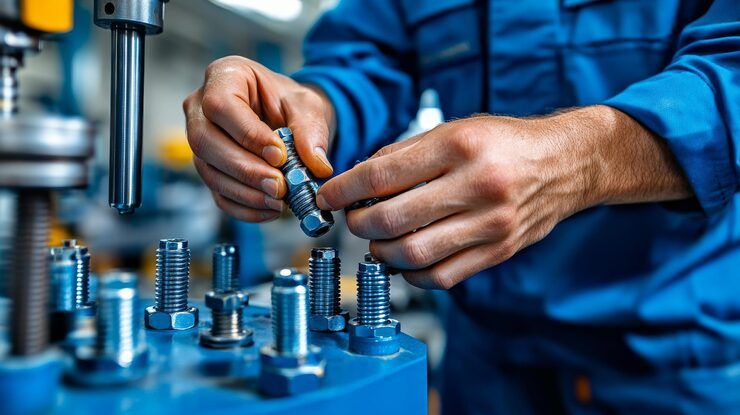
Bolts and nuts are widely used in machinery, steel structures, equipment frames, and mechanical assemblies. A bolt generally passes through aligned holes in connected components and works with a compatible nut to create a clamped joint.
Different bolt designs support different applications. Hex bolts are commonly used in general mechanical assembly, while carriage bolts feature a rounded head and a section beneath it that helps resist rotation in suitable materials.
Nuts come in several designs, including hex nuts, locknuts, and flange nuts. Their suitability depends on the connection design, thread compatibility, vibration conditions, and required installation method.
Correct thread matching is essential. A mismatch in thread diameter, pitch, or thread system can prevent proper engagement and weaken the connection.
Screws
Screws create connections by engaging with a threaded hole or forming threads in a suitable material. They are used in equipment housings, electronic assemblies, furniture, machinery panels, and many other products.
Machine screws generally work with compatible threaded holes or nuts. Self-tapping screws are designed to form or cut threads in suitable materials, depending on their design.
Head styles, drive types, thread geometry, and screw length influence installation and performance. A screw that is too short may not provide adequate engagement, while one that is too long can interfere with internal components or damage the material.
Selecting the correct screw requires consideration of the substrate, applied loads, installation access, and whether the connection may need repeated removal.
Washers
Washers are flat or specially shaped components placed beneath a bolt head, nut, or screw head. They can distribute contact pressure, protect surfaces, provide spacing, or support a specific locking arrangement.
Flat washers are commonly used to distribute load over a larger contact area. Spring washers and other locking designs have more specialized applications, and their suitability depends on the joint design.
A washer should not be treated as a universal solution to loosening. In vibration-prone assemblies, joint design, correct preload, suitable locking methods, and the condition of the connected surfaces are important factors.
Studs and Threaded Rods
Studs are threaded rods or pins used to create connections where one or both ends engage with other components. They are common in engines, flanges, industrial machinery, and equipment that requires repeated assembly and disassembly.
Threaded rods provide continuous threading over part or all of their length and can support various mounting and fastening arrangements.
These components are useful when a joint requires specific engagement lengths or when a conventional bolt is less suitable for the installation geometry. Material strength, thread condition, engagement depth, and alignment should be checked during installation.
Rivets and Pins
Rivets create permanent mechanical joints by deforming part of the fastener during installation. They are used in sheet metal fabrication, vehicle structures, enclosures, and selected structural applications.
Pins serve different purposes, including alignment, positioning, retention, and transmitting loads between components. Examples include dowel pins and cotter pins.
Unlike many threaded fasteners, rivets are not generally intended for routine removal and reuse. The choice between riveted and threaded connections depends on the design, access requirements, loading conditions, and maintenance needs.
Materials Used in Industrial Fasteners
Fastener material affects strength, corrosion resistance, temperature performance, weight, and compatibility with connected materials.
Carbon steel is widely used because it can provide a range of mechanical properties through suitable manufacturing and heat-treatment processes. Its corrosion resistance depends on the material condition and any protective coating.
Stainless steel is often selected for applications requiring improved corrosion resistance, including food-processing environments, outdoor equipment, and certain chemical-processing installations. Its performance depends on the stainless steel grade and the specific environment.
Alloy steel can provide high strength and other controlled mechanical properties for demanding mechanical and structural applications. Correct grade selection and installation remain important because strength alone does not guarantee joint reliability.
Brass and other copper alloys may be used where electrical properties, corrosion behavior, or specific material characteristics are beneficial. Aluminum fasteners can support lightweight designs, although their mechanical properties and compatibility with other metals must be evaluated carefully.
Protective finishes, such as zinc coatings, may improve corrosion resistance in appropriate environments. However, coatings have limitations, and exposure to moisture, chemicals, heat, or dissimilar metals can affect long-term performance.
Industrial Fastener Applications Across Industries
Industrial fasteners support many types of manufacturing and infrastructure.
In construction, bolts, nuts, anchors, and other fastening systems connect structural elements, support installations, and secure equipment. Structural applications require fasteners that meet the relevant design specifications and installation requirements.
In automotive manufacturing, screws, bolts, clips, and specialized fasteners hold together body panels, engine components, interior fittings, and mechanical systems. These connections must accommodate the loads, vibration, and environmental conditions associated with vehicle operation.
Industrial machinery uses fasteners to secure frames, guards, housings, motors, and replaceable components. Proper fastening helps maintain alignment and reduces the likelihood of movement between connected parts.
In electrical and electronic equipment, fasteners secure enclosures, mounting brackets, and selected electrical components. Their material, dimensions, and installation must be appropriate for the equipment's electrical, thermal, and mechanical requirements.
Aerospace, marine, energy, and railway applications may require specialized fasteners that meet strict engineering and traceability requirements. In these settings, documentation, material certification, inspection, and controlled installation procedures can be as important as the fastener's physical design.
How to Choose the Right Industrial Fastener
Selecting an industrial fastener begins with understanding the connection. Engineers and technicians should identify the materials being joined, the loads involved, the available installation space, and whether the joint needs to be removable.
Load requirements are particularly important. A connection may experience tension, shear, bending, vibration, or a combination of forces. Fastener diameter, strength grade, thread engagement, joint geometry, and installation conditions all influence its ability to perform as intended.
Environmental exposure must also be considered. Outdoor structures may require corrosion-resistant materials or protective finishes, while high-temperature equipment may need fasteners designed for elevated operating temperatures.
Thread compatibility should be verified before assembly, including diameter, pitch, thread direction, and applicable thread standards. Metric and imperial threads are not automatically interchangeable.
Finally, the fastener should meet the relevant engineering specifications, industry standards, and manufacturer requirements. Critical connections should be designed or reviewed by qualified professionals rather than selected through appearance alone.
Proper Installation and Fastener Maintenance
Correct installation is essential to fastener performance. Before assembly, users should inspect threads, bearing surfaces, and components for damage, contamination, corrosion, or deformation.
Where a specified tightening torque is required, the correct procedure and suitable calibrated tool should be used. The appropriate torque depends on factors such as fastener size, material, coating, lubrication, and joint design. Applying more torque than specified can stretch or damage a fastener, while insufficient tightening may result in inadequate clamping force.
Thread lubricants and coatings can change the relationship between torque and clamping force. They should therefore be used only as permitted by the applicable procedure.
During maintenance, technicians should look for loose connections, corrosion, damaged threads, missing fasteners, and signs of movement around joints. Replacement fasteners should meet the required specifications rather than being chosen solely because they appear to fit.
For critical assemblies, inspection intervals and replacement criteria should follow the equipment manufacturer's guidance and applicable maintenance standards.
Conclusion
Industrial fasteners are fundamental to the safety, stability, and reliability of mechanical assemblies. Bolts, nuts, screws, washers, studs, rivets, and pins each serve different purposes, while material selection and protective finishes influence performance in different environments.
Choosing the right fastener requires careful consideration of loads, connected materials, thread compatibility, corrosion exposure, installation requirements, and applicable engineering standards. Proper tightening, routine inspection, and suitable replacement practices also help maintain reliable connections over time.
By understanding industrial fastener types and their practical applications, manufacturers, engineers, and maintenance teams can make more informed decisions and support durable, well-designed mechanical assemblies.