Surface grinding machines play a vital role in modern manufacturing by producing smooth, flat, and highly accurate surfaces on metal and other materials. They are widely used in industries where precision and dimensional accuracy are essential, including automotive, aerospace, tool manufacturing, medical equipment, and industrial machinery production.
As manufacturing standards continue to become more demanding, surface grinding has evolved into an important finishing process that improves the quality, performance, and reliability of components. Whether producing machine parts, molds, dies, or precision tools, these machines help achieve tight tolerances and excellent surface finishes that many other machining methods cannot consistently deliver.
Understanding how surface grinding machines work, where they are used, and how they should be maintained can help manufacturers, engineers, students, and industrial professionals make informed decisions about precision machining processes.
What Is a Surface Grinding Machine?
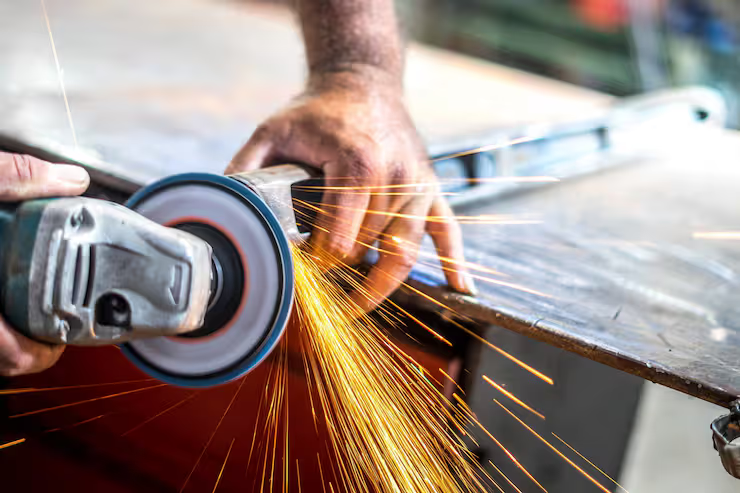
A surface grinding machine is a precision machine tool designed to remove a small amount of material from the surface of a workpiece using a rotating abrasive grinding wheel. Unlike cutting tools that remove larger amounts of material, grinding focuses on finishing, refining dimensions, and creating an even surface with minimal imperfections.
The workpiece is securely placed on a machine table, which moves in controlled directions beneath the rotating grinding wheel. The wheel gradually removes microscopic layers from the material until the desired flatness, thickness, and finish are achieved.
Surface grinding machines are commonly used after milling, turning, or other machining operations to achieve the final surface quality required for industrial components.
Why Surface Grinding Machines Are Important in Modern Manufacturing
Precision manufacturing depends heavily on processes that deliver consistent results. Surface grinding machines help achieve extremely fine tolerances while improving the appearance and functionality of finished components.
The grinding process enhances dimensional accuracy, removes machining marks, improves surface smoothness, and prepares components for assembly or coating. Many industries rely on this process because smoother surfaces reduce friction, improve sealing performance, and increase component lifespan.
Surface grinding also supports the production of interchangeable parts, making it easier for manufacturers to maintain consistent quality across large production volumes.
How Surface Grinding Machines Work
A surface grinding machine works by combining controlled movement of the grinding wheel and worktable. The grinding wheel rotates at high speed while the workpiece moves beneath it in a precise pattern.
The machine table moves longitudinally and transversely, allowing the grinding wheel to cover the entire workpiece surface. During each pass, the grinding wheel removes a very thin layer of material. Multiple passes gradually achieve the required dimensions and finish.
Grinding wheels are made from abrasive materials such as aluminum oxide, silicon carbide, cubic boron nitride, or diamond, depending on the material being processed. Coolant is often applied during grinding to reduce heat generation, prevent thermal damage, and improve wheel life.
The accuracy of the grinding process depends on machine rigidity, wheel condition, feed rate, wheel speed, and proper setup.
Main Components of a Surface Grinding Machine
A surface grinding machine consists of several components that work together to achieve precision results.
The machine base provides structural stability and absorbs vibrations during operation. The worktable holds and moves the workpiece accurately throughout the grinding process.
The grinding wheel is the primary cutting tool responsible for removing material. The wheel spindle rotates the grinding wheel at high speed while maintaining alignment and balance.
The magnetic chuck is commonly used for holding ferrous materials securely during grinding. Hydraulic, mechanical, or vacuum work-holding systems may be used for different materials and applications.
The coolant system helps maintain temperature control, flush away grinding particles, and improve surface quality. Modern machines also include control systems that regulate feed movement and grinding depth.
Different Types of Surface Grinding Machines
Surface grinding machines are available in several configurations to meet different production and precision requirements.
Horizontal Spindle Surface Grinding Machine
This is one of the most widely used types in manufacturing. The grinding wheel rotates horizontally, and its outer edge performs the grinding operation. It is commonly used for flat surfaces and precision finishing of metal parts.
Vertical Spindle Surface Grinding Machine
In this configuration, the grinding wheel rotates vertically, and the wheel face contacts the workpiece. Vertical spindle machines are suitable for larger workpieces and applications requiring higher material removal rates.
Reciprocating Table Surface Grinder
The table moves back and forth beneath the grinding wheel while gradually feeding sideways. This design is widely used for precision flat grinding and tool manufacturing.
Rotary Table Surface Grinder
Instead of moving back and forth, the worktable rotates continuously. Rotary table grinders are often used for circular components and high-production grinding applications.
CNC Surface Grinding Machine
Computer Numerical Control technology automates machine movement, grinding cycles, and dimensional control. CNC surface grinders improve repeatability, reduce manual intervention, and support complex grinding operations.
Materials That Can Be Ground
Surface grinding machines process a wide range of engineering materials depending on the grinding wheel selection.
Common materials include hardened steel, stainless steel, cast iron, aluminum alloys, brass, copper, carbide, ceramics, titanium alloys, and certain composite materials.
The grinding wheel material and operating parameters must match the hardness, brittleness, and thermal characteristics of the workpiece to achieve the desired finish without damaging the material.
Industrial Applications of Surface Grinding Machines
Surface grinding machines serve numerous industries where flatness and precision are critical.
The automotive industry uses surface grinding for engine components, brake parts, transmission components, gears, and bearing surfaces. Accurate grinding improves fit, performance, and wear resistance.
In aerospace manufacturing, turbine components, landing gear parts, structural components, and precision assemblies require tight tolerances that grinding helps achieve.
Tool and die manufacturing relies on surface grinding to produce molds, punches, dies, gauges, fixtures, and cutting tools with highly accurate dimensions.
Medical device manufacturers use precision grinding for surgical instruments, orthopedic implants, and specialized equipment where surface quality directly affects performance.
General manufacturing industries use surface grinding for machine beds, industrial rollers, precision plates, hydraulic components, and industrial tooling.
Benefits of Surface Grinding Machines
Surface grinding offers several advantages that make it an essential finishing process in industrial production.
The process delivers excellent dimensional accuracy with consistent repeatability across multiple components. It produces smooth surface finishes that improve functionality and appearance.
Grinding removes small imperfections left by previous machining processes while maintaining tight tolerances. It also improves parallelism, flatness, and squareness of machined parts.
Surface grinding supports both prototype development and mass production, making it suitable for a wide variety of manufacturing environments.
Modern grinding machines also reduce material waste by removing only the required amount of material during finishing operations.
Surface Grinding Compared With Other Grinding Processes
Grinding includes several specialized machining methods, each designed for different component shapes and requirements.
Surface grinding focuses on creating flat and smooth surfaces. Cylindrical grinding is used for shafts and round components, while centerless grinding is suitable for continuous production of cylindrical parts without centers.
Internal grinding machines finish holes and internal diameters, whereas tool and cutter grinders sharpen and manufacture cutting tools.
Surface grinding remains the preferred choice whenever flatness and surface finish are the primary objectives.
Factors That Affect Surface Grinding Quality
The final grinding result depends on several machining parameters working together.
Grinding wheel selection influences cutting performance, heat generation, and finish quality. Wheel hardness, grain size, bonding material, and abrasive type must match the application.
Feed rate affects both productivity and surface smoothness. Excessive feed can increase vibration and reduce finish quality, while slower feeds generally improve precision.
Grinding depth determines how much material is removed during each pass. Smaller depths help produce finer finishes and reduce thermal damage.
Machine rigidity minimizes vibration and improves dimensional accuracy during grinding operations.
Proper coolant application reduces grinding temperatures, prevents burns, and extends grinding wheel life.
Maintenance of Surface Grinding Machines
Regular maintenance helps maintain precision, extend machine lifespan, and reduce unexpected downtime.
Machine guideways should remain clean and properly lubricated to ensure smooth table movement. Grinding wheels require periodic dressing to restore sharp cutting edges and maintain accurate wheel geometry.
The spindle should be inspected regularly for vibration, alignment, and bearing condition. Hydraulic systems, coolant pumps, filters, and lubrication systems also require routine inspection.
Keeping the magnetic chuck clean ensures consistent workpiece holding accuracy. Removing grinding dust and abrasive particles prevents contamination that could affect machine performance.
Scheduled calibration helps maintain dimensional accuracy over long production periods.
Common Challenges During Surface Grinding
Several operational issues may affect grinding quality if machine settings or maintenance are not properly managed.
Grinding burns may occur when excessive heat damages the workpiece surface. This is often controlled through proper coolant flow and appropriate grinding parameters.
Wheel loading happens when material particles clog abrasive grains, reducing cutting efficiency. Dressing the wheel restores performance.
Surface chatter appears as vibration marks caused by wheel imbalance, loose components, or improper setup.
Dimensional inaccuracies can result from thermal expansion, worn guideways, incorrect wheel selection, or poor machine calibration.
Identifying these issues early helps maintain consistent production quality.
Safety Practices for Surface Grinding Operations
Surface grinding machines operate at high wheel speeds, making safety an important part of daily operation.
Operators should inspect grinding wheels before installation to ensure they are free from cracks or damage. Wheels must be mounted and balanced correctly before use.
Workpieces should be securely clamped using appropriate work-holding devices. Coolant systems should function correctly to control temperature during grinding.
Protective machine guards help contain grinding particles and wheel fragments if wheel failure occurs. Operators should also maintain clean work areas to reduce slipping hazards and prevent abrasive buildup around the machine.
Following manufacturer operating procedures contributes to safe and efficient grinding operations.
Recent Developments in Surface Grinding Technology
Surface grinding technology has advanced significantly in recent years with greater emphasis on automation, precision, and efficiency.
CNC surface grinders now include intelligent programming features that simplify setup and improve repeatability for complex components. Automatic wheel dressing systems reduce downtime and maintain consistent grinding quality.
Digital monitoring systems track spindle performance, vibration levels, coolant flow, and machine health, allowing predictive maintenance before failures occur.
Advanced grinding wheels made from superabrasive materials improve performance when grinding hardened steels, ceramics, and carbide materials.
Manufacturers are also adopting energy-efficient coolant filtration systems and environmentally responsible grinding fluids to improve sustainability in industrial production.
Integration with smart manufacturing systems enables grinding machines to share production data with factory management software, improving quality control and production planning.
Choosing the Right Surface Grinding Machine
Selecting an appropriate surface grinding machine depends on production requirements, workpiece size, material type, and accuracy expectations.
Manufacturers should evaluate table size, spindle orientation, wheel compatibility, automation level, control system capabilities, and maintenance requirements before selecting a machine.
Production volume also influences machine selection. Manual surface grinders remain suitable for repair shops and small-scale precision work, while CNC grinders support high-volume manufacturing with greater consistency.
Considering future production needs can help organizations choose equipment that supports long-term operational efficiency.
Conclusion
Surface grinding machines are an essential part of precision manufacturing because they deliver flat, smooth, and dimensionally accurate surfaces across a wide range of industrial applications. From automotive components and aerospace parts to molds, dies, and medical equipment, these machines help manufacturers achieve high-quality finishing standards that improve product performance and reliability.
As manufacturing technology continues to evolve, surface grinding machines are becoming more automated, intelligent, and efficient. CNC controls, advanced abrasives, digital monitoring, and predictive maintenance are improving productivity while maintaining exceptional precision. Understanding the working principle, machine types, applications, maintenance practices, and safety considerations provides a strong foundation for anyone involved in modern machining and industrial manufacturing.
Well-maintained surface grinding machines not only improve production quality but also contribute to longer equipment life, consistent accuracy, and efficient manufacturing processes across industries.